

-
 24 April 2025
Listeners use gestures to predict upcoming words
In face-to-face conversations, speakers use hand movements to signal meaning. But do listeners actually use these gestures to predict what someone might say next? In a study using virtual avatars...
-
 17 April 2025
Rowena Garcia and Hasan Dikyuva featured at ACLC
The Amsterdam Center for Language and Communication (ACLC) is marking its 25th anniversary with a conference on Inclusivity in Language, and we’re excited to share that two MPI colleagues will be...
-
 01 April 2025
Genes may influence our enjoyment of music
Music is central to human emotion and culture. Does our ability to enjoy music have a biological basis? A genetic twin study, published in Nature Communications, shows that music enjoyment is partly...
-
 14 March 2025
Michael Erard’s Bye-Bye, I Love You Explores the first and last words of language
Linguist, journalist, and author Erard unveils his latest book, Bye-Bye, I Love You: The Story of Our First and Last Words, an exploration of how language begins and ends across human lives and...
-
 26 February 2025
Natascha Roos defends thesis 28 February
On 28 February at 10:30 am, Natascha Roos will defend her thesis 'Naming a Picture in Context: Paving the way to investigate language recovery after stroke' in the Aula of the Radboud University. The...
-
 19 February 2025
InScience Film Festival meets MPI
At InScience International Science Film Festival Nijmegen, film and science inherently coincide. This platform highlights this exciting cross-pollination.
-
 12 February 2025
Giulio Severijnen defends thesis 14 February
On 14 February at 10:30 am, Giulio Severijnen will defend his thesis 'A blessing in disguise: How prosodic variability challenges but also aids successful speech perception' in the Aula of the Radboud...
-
 11 February 2025
Podcast by Peter Hagoort on human language ability
Human language ability is unique, and we are gaining an increasingly clear understanding of how our brain functions when we speak and listen. The development of theories continues, and the resolutions...
-
 21 January 2025
Building sentence structure may be language-specific
Do speakers of different languages build sentence structure in the same way? In a neuroimaging study published in PLOS Biology, scientists from the Max Planck institute for Psycholinguistics, Donders...
-
 09 January 2025
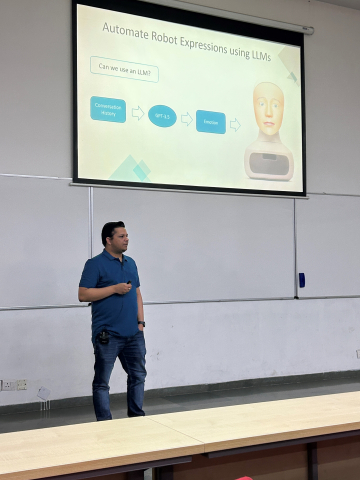
Chinmaya Mishra on Facial Cues in Human-Robot Interaction at IIIT Delhi
Chinmaya Mishra recently delivered an insightful talk at IIIT Delhi titled “The Perception and Generation of Facial Cues in Human-Robot Interaction (HRI)”, shedding light on the critical role of non...


Share this page