Primary tabs
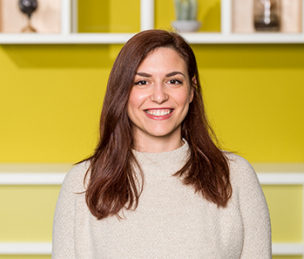
I am a doctoral candidate at the Max Planck Institute for Psycholinguistics since February 2022. In my PhD project, I will be investigating how speakers are able to manage the speed-accuracy trade-off in conversation. For the first study of my project, I am mainly interested in exploring the nature of the errors speakers make under time pressure and the factors that explain their preference over producing correct utterances.
Previous education
I obtained a Bachelor's degree in English Language and Literature from Aristotle University of Thessaloniki, Greece. There, I attended a number of courses in theoretical and applied linguistics, as well as English and American Literature. My curiosity about the mechanisms of language production and comprehension led me to move to the Netherlands in order to do a Research master's in Linguistics at Utrecht University. After attending courses on various linguistic fields, I fell in love with psycho- and neurolinguistics. So, I decided to do my internship and thesis at the Donders Centre for Cognition, where I studied the neural mechanisms underlying word planning processes following contexts that differ in modalities (verbal vs. non verbal) and syntactic structure (structured vs. unstructured).
Share this page